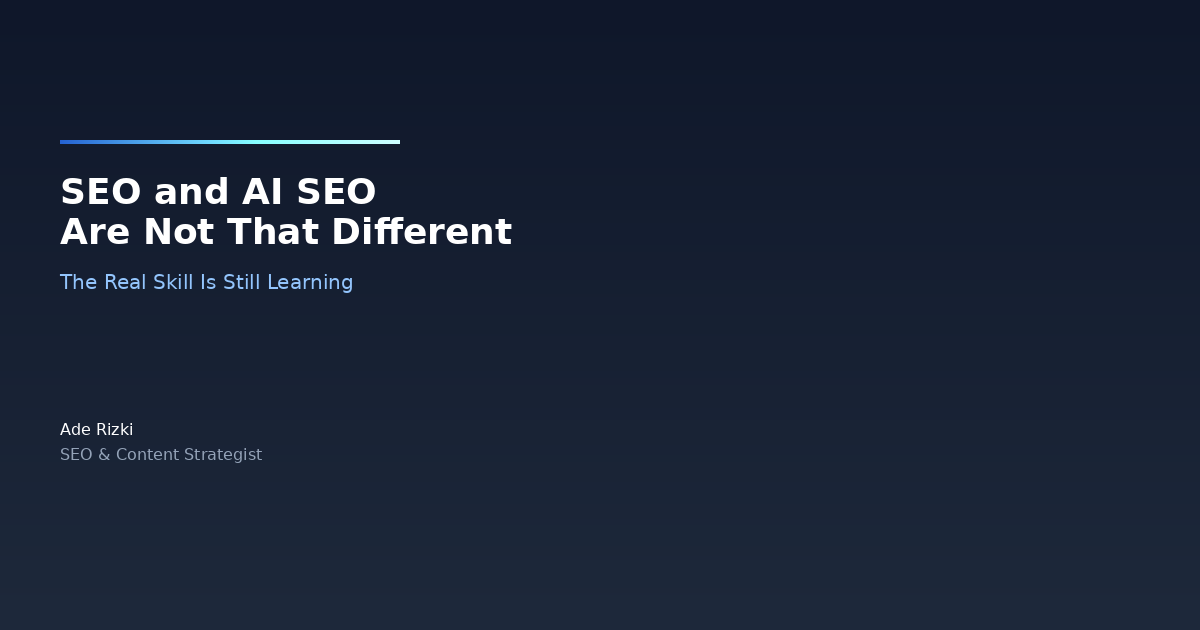
SEO and AI SEO Are Not That Different: The Real Skill Is Still Learning
There is a new fear in the SEO industry.
Every few months, a new term appears: AI SEO, GEO, AEO, LLM optimization, answer engine optimization, AI visibility, and many others. Suddenly, many SEO Specialists feel like the old playbook is no longer enough.
Some people say SEO is dying. Some say Google is no longer the only battlefield. Some say we need to completely change how we work.
But after working across SEO, consulting, content strategy, and freelance projects, I have started to see it differently.
SEO and AI SEO are not really two completely different things.
The surface has changed. The platforms have changed. The way users search, compare, and make decisions has changed. But the core job of an SEO Specialist is still the same:
We learn.
We research.
We analyze. We understand users, content, technology, markets, competitors, and change itself.
That has always been the real work of SEO.
What Is Actually Different Between SEO and AI SEO/GEO?
Traditional SEO has always focused on helping websites become more visible in search engines.
We optimize technical foundations, content relevance, keyword targeting, internal links, authority signals, and user experience so that search engines can crawl, understand, rank, and recommend our pages.
AI SEO or GEO expands that visibility challenge.
Now, users are not only searching through Google's blue links. They also ask questions through AI platforms, generative search experiences, chatbots, AI assistants, and answer engines.
Instead of only looking for a ranked list of websites, users increasingly expect:
- summarized answers,
- recommendations,
- comparisons,
- direct explanations,
- and clearer decision support.
That means the visibility layer is changing.
From Ranking Pages to Being Part of the Answer
In traditional SEO, the question was often:
"Can we rank for this keyword?"
In AI SEO/GEO, the question becomes:
"Can our brand, product, expertise, or content be understood, trusted, and selected as part of the answer?"
This is an important difference.
But the work behind it is not entirely new.
To appear in AI-generated answers, we still need:
- strong content,
- clear positioning,
- technical accessibility,
- authority,
- structured information,
- and a deep understanding of user intent.
The difference is that SEO is no longer only about ranking pages.
It is about building discoverability, understanding, and trust across multiple search and answer environments.
The Key to Becoming a Contemporary SEO Specialist
For me, the modern SEO Specialist is not someone who only knows how to use SEO tools.
A contemporary SEO Specialist is someone who can connect different layers of information and turn them into a practical direction.
We need to understand how users think.
We need to understand how search engines interpret content.
We need to understand how AI systems summarize information.
We need to understand how businesses communicate value.
We need to understand how competitors position themselves. We need to understand how content can influence decisions, not only generate traffic.
This is why SEO today requires more than keyword research.
Keyword research is still important, but it is no longer enough.
We need to understand the "why" behind the query.
The Real Questions Behind Modern SEO Work
A contemporary SEO Specialist should be able to ask:
- What does the user actually want to solve?
- What alternatives are they comparing?
- What proof do they need before they trust a brand?
- What language does the market use?
- What information is missing from existing search results?
- What makes one answer more useful than another?
- How can a brand become easier to discover, understand, and choose?
The best SEO Specialists are not just traffic hunters.
They are researchers, analysts, strategists, content thinkers, and business translators.
They can look at data and ask:
"What does this mean for the business?"
They can look at content and ask:
"Is this actually helpful for the user?"
They can look at competitors and ask:
"What gap can we own?"
They can look at AI search and ask:
"How can we make this brand easier to understand, cite, compare, and recommend?"
That is the contemporary SEO mindset.
What Should SEO Specialists Do Now?
First, we need to stop treating AI SEO as something completely separate from SEO.
Of course, we need to learn new platforms, new behaviors, and new measurement methods. We need to test how brands appear in AI-generated answers. We need to observe which sources are cited, which competitors are mentioned, and what kind of content gets picked up.
But we should not forget the fundamentals.
Strong SEO foundations still matter.
A website that is hard to crawl, unclear in structure, weak in content, or vague in positioning will also struggle in AI-driven discovery.
1. Become Better at Research
Not only keyword research, but real research.
Research the user.
Research the market.
Research the product.
Research the competitor.
Research the language people use.
Research the questions people ask before they buy. Research the objections that stop them from converting.
AI search makes this even more important because AI systems do not only match keywords. They summarize meaning, connect entities, compare options, and generate answers based on available information.
If our content is shallow, generic, or unclear, there is nothing strong to be understood.
2. Improve Content Quality
"Quality content" does not mean longer content.
It means clearer, more useful, more specific, and more credible content.
A good piece of content should help users make progress. It should answer the real question, not just repeat the keyword.
It should include:
- context,
- explanation,
- comparison,
- proof,
- examples,
- and next steps where relevant.
For AI SEO/GEO, content should also make the brand easier to understand.
What does the company do?
Who is it for?
What problem does it solve?
Why is it credible?
What makes it different? In what situation should users choose it?
If that information is not clear on the website, we cannot expect search engines or AI platforms to explain it better than we do.
3. Measure Visibility Differently
Ranking is still useful, but it is no longer the only signal.
We need to look at:
- organic traffic,
- impressions,
- clicks,
- engagement,
- conversions,
- branded search,
- non-branded visibility,
- AI mentions,
- answer inclusion,
- competitor comparison,
- and how often the brand appears in high-intent discovery moments.
The future of SEO reporting should not only say:
"We ranked higher."
It should also explain:
"Are we becoming easier to discover, understand, and choose?"
Learning Points from Working as a Consultant and Freelancer
Working as both a Consultant and Freelancer has taught me one important lesson:
SEO is not just about knowing the answer. It is about knowing how to find the answer.
Every client, industry, product, and market is different.
Sometimes the data is incomplete.
Sometimes the business context is unclear.
Sometimes the client does not need a complex SEO explanation; they need a clear direction. Sometimes the best recommendation is not the most advanced one, but the most practical one.
That is where the real consulting skill comes in.
Translating Complexity Into Clarity
As SEO Specialists, we need to translate complexity into clarity.
Clients do not only need keyword lists.
They need to understand:
- what opportunity exists,
- what problem should be prioritized,
- what action should be taken,
- and why it matters for the business.
Freelancing also teaches another lesson: ownership.
When working independently, we cannot hide behind a process. We need to understand the objective, manage expectations, ask better questions, deliver useful outputs, and make sure the work actually helps the client move forward.
That mindset is also useful in AI SEO/GEO.
Because this field is still evolving, no one has a perfect fixed playbook. We need to test, observe, compare, and learn continuously.
We need to be comfortable with uncertainty, but still able to give practical recommendations.
That is why I believe the most important SEO skill today is not memorizing tactics.
It is adaptability.
SEO Is Still SEO, But the Standard Is Higher
AI will not make SEO irrelevant.
But it will expose weak SEO work faster.
Generic content will become easier to ignore. Vague positioning will become easier to miss. Thin analysis will become less useful. SEO reports that only show rankings without business meaning will feel incomplete.
At the same time, strong SEO work will become even more valuable.
Because brands will need people who can help them understand:
- how users search,
- how AI answers,
- how competitors appear,
- how content should be structured,
- and how the business can become more visible across changing discovery channels.
So yes, the terminology may change.
SEO may be called AI SEO, GEO, AEO, or something else in the future.
But the core remains the same.
We study how people search.
We study how systems understand.
We study how markets move.
We study how content builds trust. We study how brands become discoverable and chosen.
That is the real work.
SEO is not only about algorithms.
It is about learning faster than the environment changes.